01, Strategy
Flexible credit model
From a flat burn per dashboard to a credit currency that flexes per action. Standard generations stay cheap. Pro reasoning models and Auto-Insights cost more. One wallet across the whole product.
What it unlocks
The capabilities this puts in front of customers
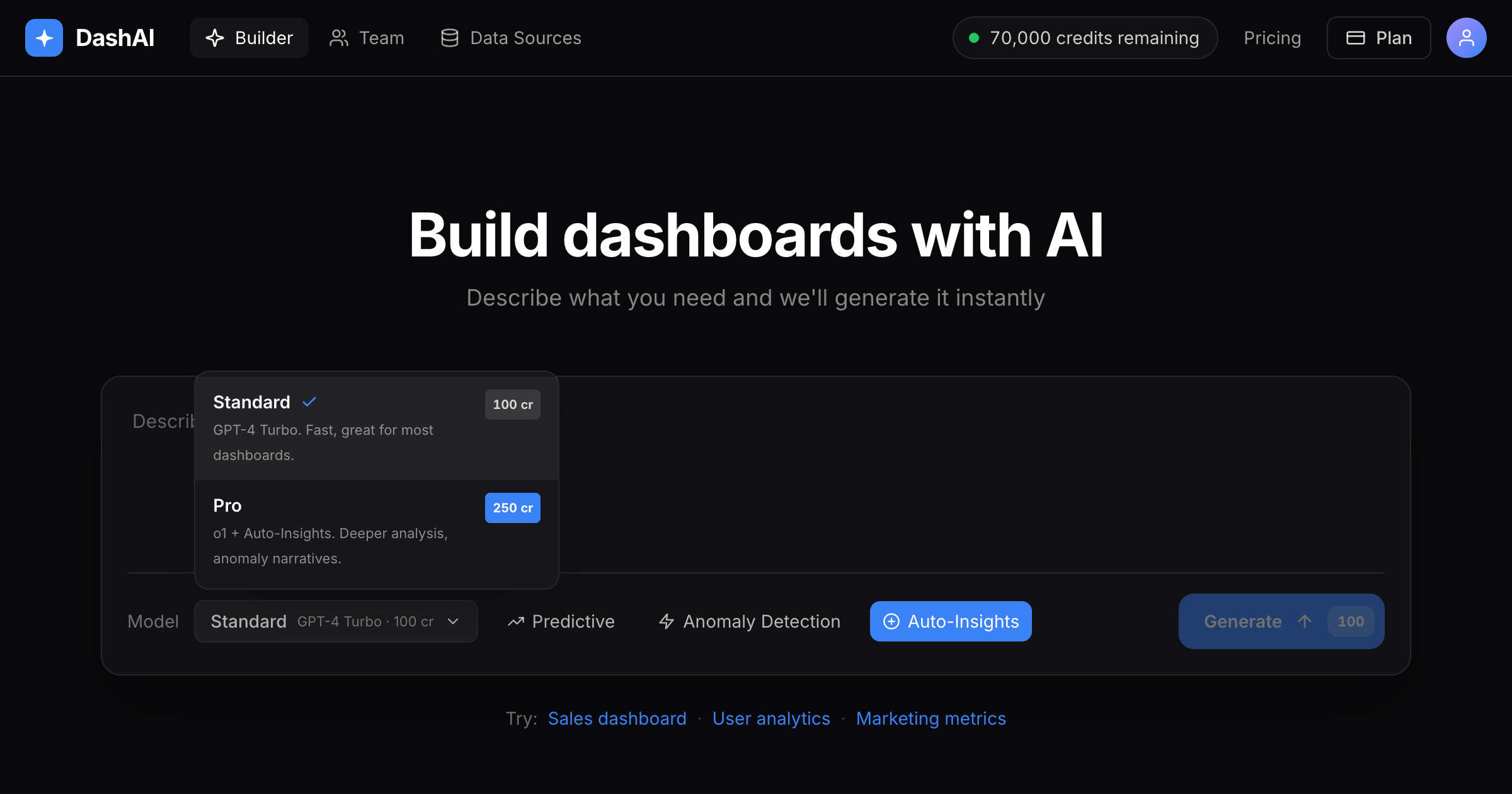
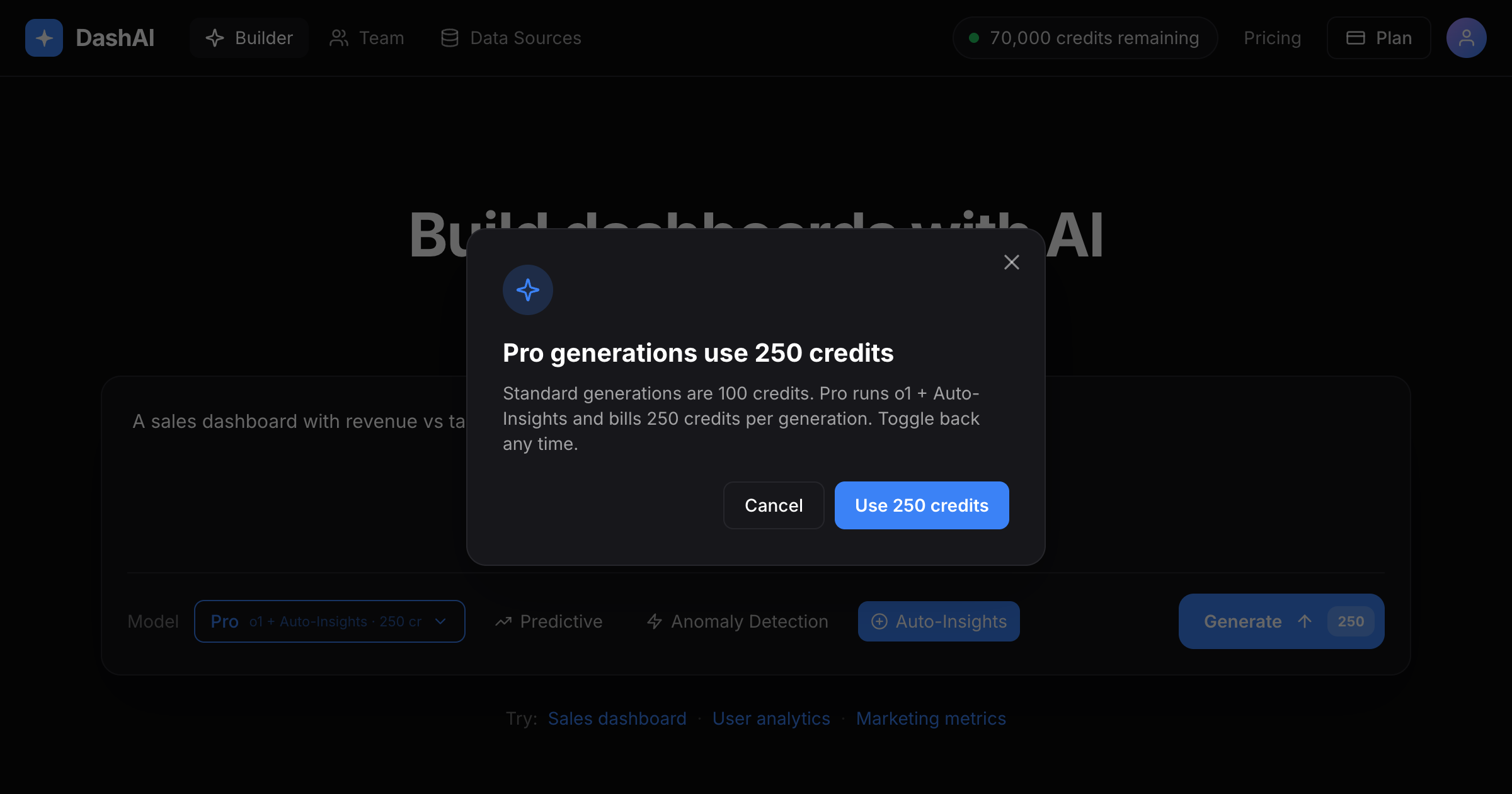
Variable cost per action. A standard dashboard generation burns 100 credits. A Pro generation with o1 reasoning and Auto-Insights burns 250. Scheduled refreshes and data syncs can join the same wallet later. One currency, every feature, transparent cost at the point of action.
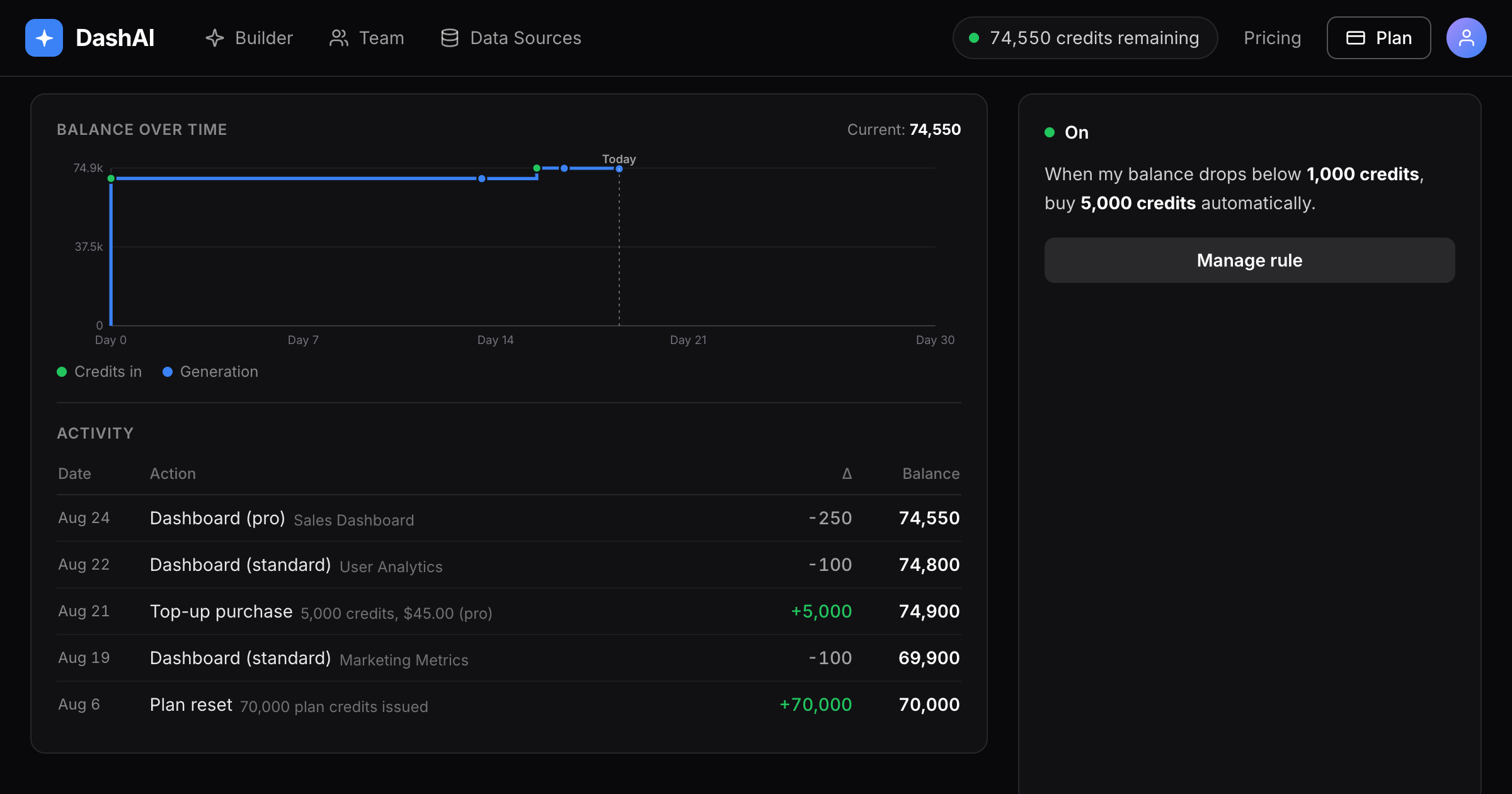
Rollovers, because credits are a balance, not a count. Unused credits carry into next month instead of evaporating at the reset boundary.
Real activity visibility. Every generation, top-up, and rollover lands in one ledger you can read like a bank statement, with a balance-over-time chart on the Plan page.
Top-ups, because you can sell a quantity of credits without dragging a user through a plan switch.
Business impact
The metrics this is supposed to move
ARPU lift. Credit pricing puts o1-class reasoning runs in line with their actual compute cost. Today a flat burn means heavy Pro users are subsidized by everyone on standard models.
Conversion. A raw counter ticking down feels like a tax meter. A wallet you can refill feels intuitive. Wallets convert.
Margin. The same plan grosses more when the most expensive actions cost more credits.
Retention. Rollovers smooth lumpy analytics work. A team sprints before a board meeting, idles for two weeks, and the product follows that rhythm instead of fighting it.
Competitive landscape
How the market runs the play
Snowflake made 'credits' the unit of an entire industry. Warehouse size sets the burn rate, and buyers learned to think in credits per workload.
Databricks sells DBUs the same way. Variable-cost compute behind one meter is the default expectation for anyone buying data tooling.
Hex meters compute credits on top of seats. Heavier kernels draw down faster. The model works at exactly Dash AI's buyer.
OpenAI prices per token with different rates per model. Users accepted that a smarter model costs more per action years ago.
Customer mindset
How users actually think about this
"How many dashboards can I build this month?" beats "what's this number in the corner?". The first is countable in the user's head. The second feels random.
Power users want predictability. They want to know what a Pro generation costs before they hit Generate. A credit price on the button gives them that.
Light users want forgiveness. Rollovers protect a slow month.
Analysts think in projects, not months. Two weeks of nothing then a reporting sprint is normal. The pricing model should bend to that, not against it.
How Schematic supports it
What you don't have to build yourself
Metering primitives handle variable-cost actions natively. Each generation is a metered event with a credit cost attached. No bespoke math.
The entitlement model maps cleanly: plan grants base credits, top-ups and rollovers stack into the same balance, consumption order is configurable.
Customer-level overrides let you bump a heavy account's monthly grant without changing their plan. That's how you keep your noisiest paying customers without rewriting the price book.
Schematic emits webhook events on usage thresholds, which is what wires in-product upgrade prompts and email nudges without bespoke event plumbing.
Walk the flow
Open the prototype to see this strategy in action.