03, Strategy
Free plan
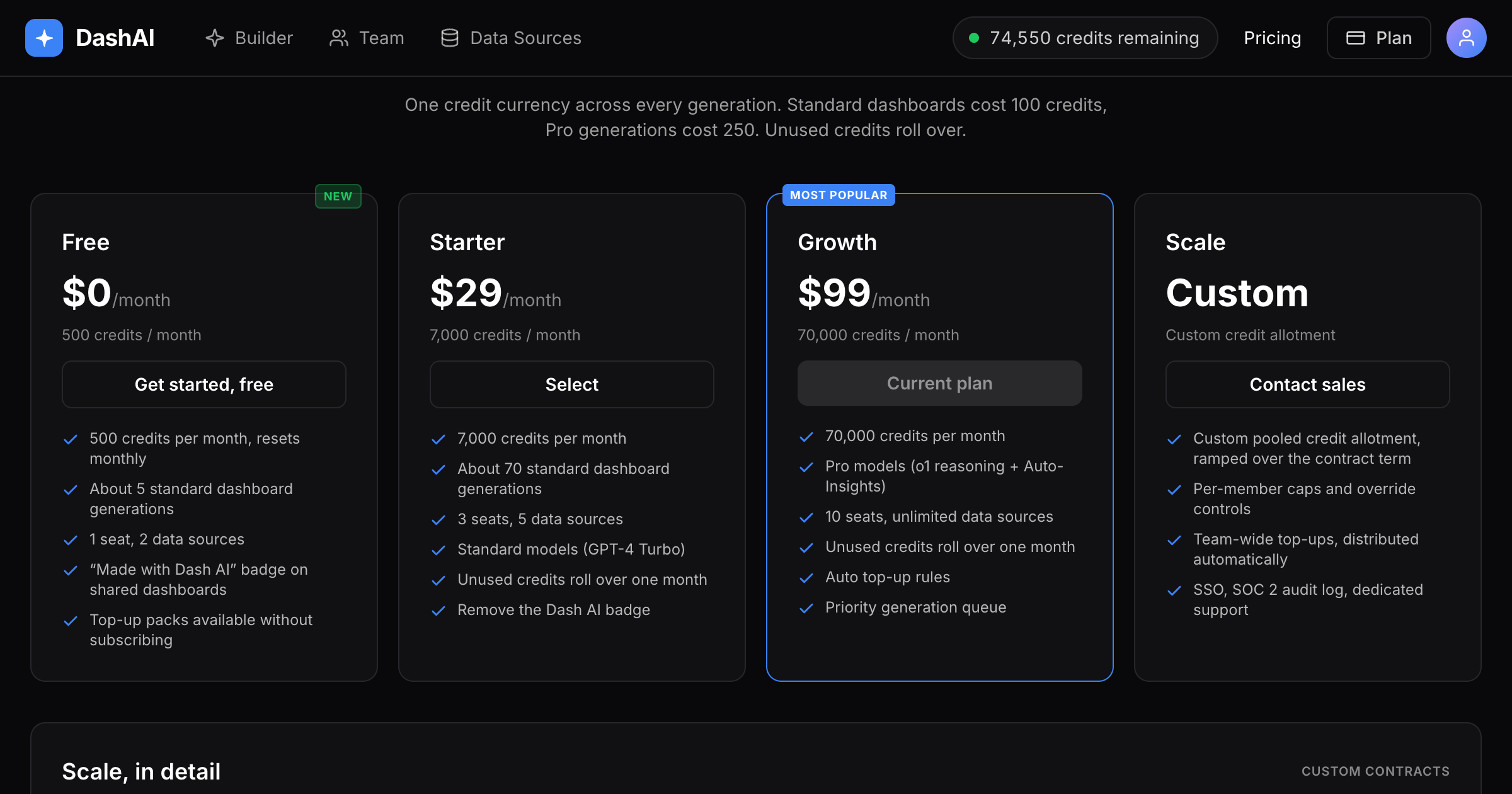
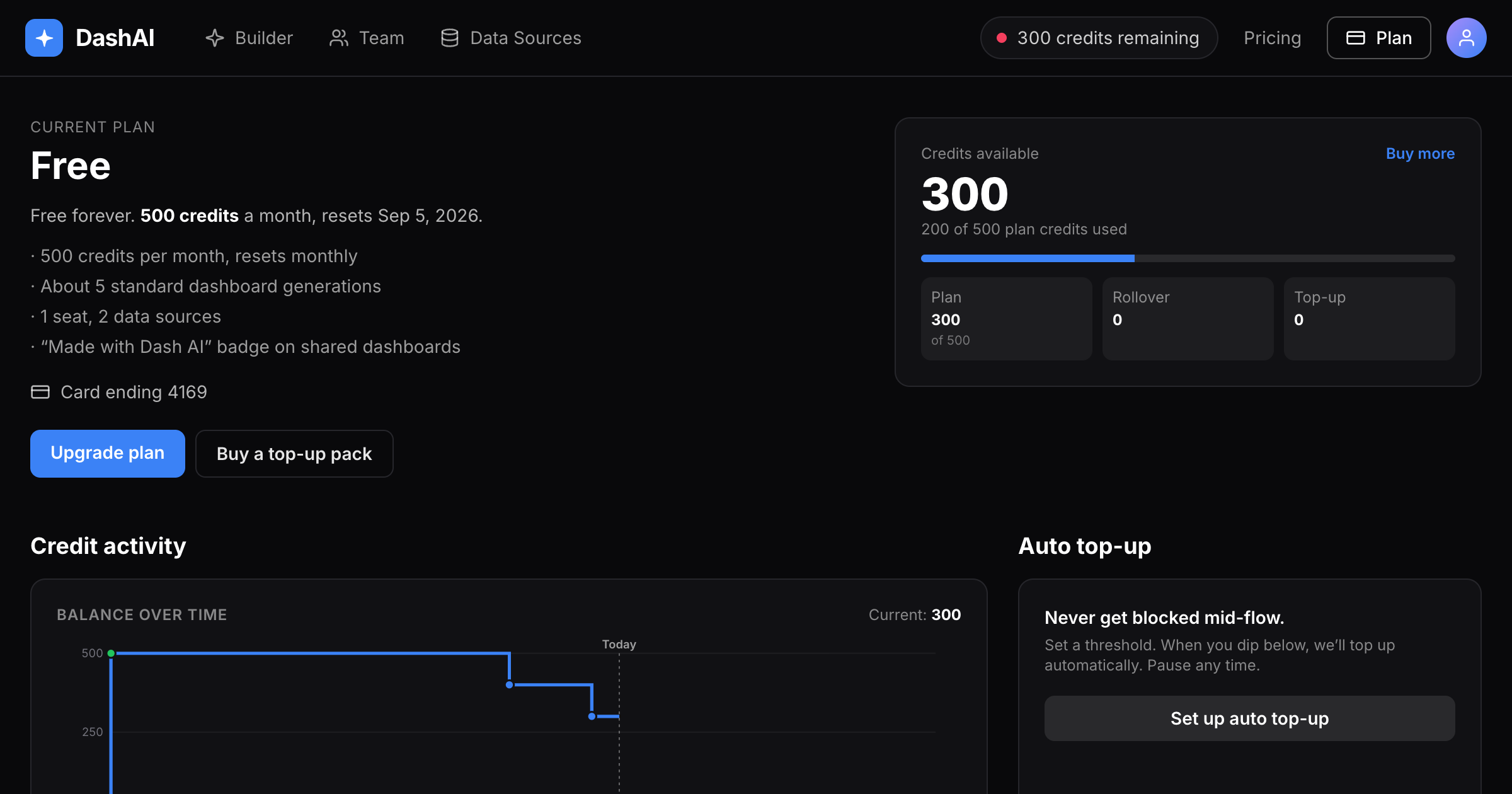
500 credits a month, about five dashboards. One seat, two data sources, a 'Made with Dash AI' badge. A real entry point that doesn't cannibalize Starter.
What it unlocks
The capabilities this puts in front of customers
A real free funnel. 500 credits a month is about five standard dashboards — enough to connect a data source, build something real, and share it with a boss.
A taste of the credit model. Free users learn the price of each action and arrive at the upgrade conversation with clear-eyed expectations.
Top-ups without a subscription. Free users hit the wall mid-month, buy a $10 pack, keep going. Some convert to Starter, the rest become recurring micro-payers.
A distribution engine. Every shared free dashboard carries a 'Made with Dash AI' badge. The output of the product becomes the ad for the product.
Business impact
The metrics this is supposed to move
TAM expansion. Subscription-only locks out solo analysts, founders, and side projects who together dwarf the paid segment by an order of magnitude.
Conversion lift to Starter. A free user who's burned 500 credits and priced top-ups at $10/1,000 is being primed to value $29/mo for 7,000.
Marginal cost is small. 500 credits a month is a few dollars of compute per active free user per year. A 2% conversion rate to a $348 ARR plan pays for the rest.
A defensive move. Free BI tools are the default starting point for small teams. Without a free tier, Dash AI never even enters the consideration set.
Competitive landscape
How the market runs the play
Looker Studio is entirely free and funnels users into the Google Cloud ecosystem. It owns the 'first dashboard' moment for a huge share of the market.
Metabase gives the whole product away open-source and monetizes hosting and enterprise features. Free is their entire top of funnel.
Hex runs a free tier with limited compute — exactly the credit-capped freemium shape this proposal describes.
Tableau Public is free with public-only publishing. The share-with-a-badge mechanic is proven: public dashboards recruit the next user.
Grafana Cloud's generous free tier built the default mindshare in observability dashboards. Same playbook, adjacent market.
Customer mindset
How users actually think about this
"Can I try it without a credit card?" is the entrance gate. 500 credits a month clears it without feeling stingy.
The badge is a fair trade. Solo users don't mind attribution; companies do — which is exactly the pressure that converts the company.
Hobbyists rarely subscribe. They happily pay $10 a few times a year. Free plus top-ups captures the segment without forcing them into a sub.
Two data sources is the right fence. Enough to prove value on real data, low enough that a real team outgrows it in a week.
Monthly reset hooks engagement. A user who returns each month to check their credit balance is a user the conversion engine can talk to.
How Schematic supports it
What you don't have to build yourself
A $0 plan with a metered entitlement is core Schematic, no bespoke code.
Seat and data-source fences are boolean and numeric entitlements on the same plan record. The badge is a plan-level flag checked at render time.
Monthly reset is a scheduled entitlement renewal on the customer record.
Free-tier abuse mitigation runs through Schematic's customer attributes. Signup velocity and email-domain heuristics are queryable in fraud rules without standing up a separate service.
Conversion prompts triggered by Schematic events (balance hit zero, gated action attempted) surface through the SDK at the moment of friction. That's where free-to-paid conversion actually happens.
Walk the flow
Open the prototype to see this strategy in action.